 You are here: Home > All About Hand Dyeing > About Dyes > Fiber Reactive Dyes > Reactive dyes on protein fibers
Advertisements
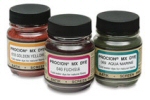 Procion MX Fiber Reactive Dye

The same types of fiber reactive dyes that are the best of all dyes on cotton and other cellulose fibers, including Procion MX, Cibacron F/Sabracron F, and Drimarene K, among others, can also be used as acid dyes to dye wool. An acid dye recipe must be used, with vinegar or other acid replacing the soda ash (base) used in dyeing cotton. As with all acid dyes, boiling or heat-setting of some sort is generally required. (PROchem's recipes include one which uses black plastic bags to absorb heat from the sun for this purpose.)
For recipes, use any acid dye recipe, or see:
Even when following the identical recipe, fiber reactive dyes mixtures, such as black, may yield quite different colors on protein fibers than they do on cotton and other cellulose fibers. The reason for this is that some of the dyes in the mixture may work better on one fiber than another, to a greater or lesser extent, so a dye mixture must be prepared differently for each different fiber. The color shift tends to be less dramatic when acid is used with Procion MX dyes than when the same dye mixtures are used on silk with sodium carbonate, but don't expect the colors of dye mixtures to be the same.
Do not use black Procion MX dye mixture if what you want is black silk. (It may yield other very interesting and lovely colors, however.)
However, the pure dye colors appear to produce identical hues regardless of the fiber on which they are used. If you wish to make matching items using different fibers, stick to the pure unmixed single hue fiber reactive dyes. (I maintain a list of the different single-hue Procion MX type dyes from various suppliers.)
Some of the Lanaset dyes, also known as Sabraset or Telana dyes, are actually fiber reactive dyes which are designed for use on wool, rather than cotton. They are used at an acid pH. See Lanaset dyes.
It is generally agreed that the best dye to use to make black on silk, wool, or nylon is the Lanaset Black, or another premetalized (metal complex) acid dye. There is no concern about color shifts, and the black produced is very rich and dark. Fiber reactive dyes tend to be smaller molecules, producing brighter colors, and may be less effective at producing a very dark color.
This discussion would not be complete without a mention of the fact that the vinyl sulfone dyes (Remazol dyes) can be used as true fiber reactive dyes on wool, which means that they attach via very strong covalent bonds, stronger than the bonds that hold acid dyes to the fiber. One recipe requires simmering the wool in a dyebath with vinyl sulfone dyes for forty-five minutes. See Vinyl Sulfone Fiber Reactive Dyes.
All of the pages on this site are copyright ©1998‑2026 Paula E. Burch, Ph.D.
Page created: May 8, 2005
Last updated: January 26, 2010
Downloaded: Friday, September 18, 2026