 You are here: Home > All About Hand Dyeing > About Dyes > Fiber Reactive Dyes > Vinyl Sulfone Fiber Reactive Dyes
Different brand names are applied to the vinyl sulfone dyes for sale. In the US, they are available as PRO Chemical & Dye's Liquid Reactive Dyes, as Createx Colors Liquid Fiber Dyes (now discontinued), and as Jacquard Red Label Silk Colors. In Australia, they are sold under the name of Remazol dyes by Batik Oetoro and by KraftKolour. In Europe, they are sold as Granat Remazolfarver by Granat Farvekompagniet, in Denmark, as Tobasign Dyes by Tobasign, in Spain, and as Ostazin V dyes by Synthesia in the Czech Republic.
The Remazol brand name is owned by Dystar, which still manufacturers many vinyl sulfone dyes. Vinyl sulfone dyes are also manufactured by other companies now. Dystar has obtained Oeko-Tex Standard 100 certification (PDF) for many of its Remazol and Procion HE dyes.
Notice, in the table below, that each company carries different Remazol dyes. You may find that only one company carries your very favorite dye color. A similar color can often be mixed from other primaries, but it may have slightly different properties, or be less glowingly bright, or perhaps less subtle. In most cases, they also sell a number of other useful colors, which they have blended from two or more other colors. These can be good to use, but to truly know the properties of your dyes, you must consider them individually. You can also mix any color you wish, if you start with a good set of primaries, ideally including colors that closely approximate the cyan, magenta, and yellow widely used as printer's primaries, plus some dull, dark colors to be used in mixing dark, deep shades. Unlike most types of fiber reactive dyes that can be used at room remperature, the vinyl sulfones include a couple of single-color unmixed blacks.
Each of these dye companies sells the dye directly to the public through their web site, except for Createx Colors and Jacquard, both of which sell through multiple retailers. One supplier for Createx Colors is Dick Blick; one supplier for Jacquard Red Label Silk Colors is Jalt.com, and they can be special-ordered from Dharma Trading Company. [Createx Remazols have been discontinued from all sources, although there was a report from a user that one can still buy them by calling the Createx company directly.]
Note that not every dye in each line of dyes is of this dye class. Jacquard includes one Procion H-E bifunctional dye as their Red Label Magenta. PRO Chemical & Dye's Fuchsia LR308 uses instead a magenta from the Levafix line, Levafix Brilliant Red E-6BA, which I find very beautiful. ProChem's Sun Yellow and Golden Yellow are of undisclosed dye types (their 'Golden Yellow' is more tan than golden in color). Although Dylon Permanent, Dylon Washing Machine, and Dylon Hand dyes all contain mostly Drimarene K type dyes, their Black contains mostly Reactive Black 5, a highly satisfactory Remazol type dye.
Recommended mixing primaries in the Jacquard Red Label line are yellow, magenta, cyan, and black; their web site includes a table for mixing different colors from these four. Don't use ProChem's 'Golden Yellow' as a mixing primary, because it is a tan color, not yellow, to my eye; it should be very useful as a toning mixer, however, for dulling down overly bright color mixtures. ProChem's 'Sun Yellow' is a good bright color for mixing, as are their Intense Blue and Turquoise; I personally prefer their Fuchsia to their Mixing Red as a primary.
In the table below, "JR" stands for Jacquard Red Label Dyes; "BO" stands for Batik Oetoro; "KK" for Kraftkolour; "GF" stands for Granat Farvekompagniet; and SYN stands for Synthesia. "PRO" stands for PRO Chemical & Dye. Note that Jacquard Red Label Silk Colors also include many other colors, which are, according to the manufacturers, mixtures of two or more colors of dye.
Jacquard Green Label Silk Colors contain the same dyes as Jacquard Red Label Silk Colors, but in the Green Label dyes, the concentration is half that of the Red Label dyes, and the Green Label dye mixtures have been acidified and appear to contain some (unidentified) chemicals not found in the Red Label dye mixtures. Jacquard Red Label Silk Colors are more dilute than ProChem's Liquid Fiber Reactive Dyes; Jacquard Red Label Black 759 is approximately one-fourth the strength of ProChem's Black 50% LR604.
The notes in the right hand column, below, are merely points of interest. I do not believe that the metals contained in a few of the dyes amount to enough to cause problems with disposal in home septic systems. It's interesting, to me, to note that blues often contain copper, since copper compounds themselves are often beautiful blues.
| code | CI name | other names | retailers | notes |
|---|---|---|---|---|
| Yellow GR | Reactive Yellow 15 | Gelb GR | BO, GF, SYN | no metals |
| Yellow RTN | Reactive Yellow 24 | Gelb RTN | GF | |
| Yellow GL | Reactive Yellow 37 | Brill. Gelb GL JVS 600 Bright Yellow | GF, KK, JVS | incl. in PRO Leaf Green; JVS fair/good disch.; excellent lightfastness |
| Yellow FG | Reactive Yellow 42 | SYN | ||
| Yellow R | Reactive Yellow 77 | BO, GF | dischargeable (?) | |
| Yellow 3R | ? | JVS 601 Golden Yellow | JVS | dischargeable (?); JVS fair/good disch; fair lightfastness |
| Yellow R4GL | Reactive Yellow 160 | Brill. Gelb 4GL | GF | dischargeable (?) |
| Yellow 4G | Reactive Yellow 186 | SYN | dischargeable (?) | |
| Orange 2R | Reactive Orange 7 | |||
| Orange 3R | Reactive Orange 16 | Brill. Orange 3R; Red Label 706 Apricot; Strong Orange LR202 | JR, BO, GF, KK, PRO, SYN | dischargeable (?) |
| Orange 2G | Reactive Orange 72 | |||
| Orange 2RL | Reactive Orange 82 | |||
| Golden Yellow RNL | Reactive Orange 107 | KK | ||
| Bordeaux B | Reactive Red 49 | Bordox B; Red Label 717 Digital JV 604 Bordeaux | JR, JV, GF | JVS 20% strength |
| Rubine CB | Reactive Red 60 | |||
| Red C2G | Reactive Red 106 | |||
| Red R2G | see above? | JV 602 Red | 25% strength; fair/good disch.; fair lightfastness | |
| Red BS | Reactive Red 111 | |||
| Red 3BSA | ? | JVS 603 Magenta | JVS | |
| Red 5B | Reactive Red 35 | SYN | ||
| Procion H-E 8B | Reactive Red 152 | Red Label 715 Magenta | JR | reactive red #152 is actually a binfunctional dye, Procion H-E 8B, not a vinyl sulfone |
| Levafix Brilliant Red E-6BA | Reactive Red 159 | BO | not a vinyl sulfone: found in PRO LR 308 Fuchsia and mixtures | |
| Red 6B | Reactive Red 174 | BO | ||
| Red RF3B | Reactive Red 180 | Brill. Rot F3B | GF, KK | no metals; dischargeable (?) |
| Red RB | Reactive Red 198 | Red VS-MRBL Mixing Red LR305 | PRO, SYN | |
| Red Violet R | Reactive Violet 4 | |||
| Violet 5R | Reactive Violet 5 | Brill. Violet 5R; Red Label 718 Purple | JR, BO, GF, KK ,SYN | non-dischargeable (?) |
| Blue R (Special) | Reactive Blue 19 | Red Label 722 Royal Blue; Intense blue LR406 JV 606 Blue? | JV?, JR, BO, GF, KK, PRO, SYN | no metals; non-dischargeable (?) |
| Blue R? | see above? | JVS 606 Blue? | JVS | good disch; fair lightfastness |
| Turquoise Blue G | Reactive Blue 21 | Türkisblau G133 | BO, GF, KK, PRO, SYN, JV? | contains copper PRO describes as "copper phthalo- cyanine dye solution"; non-dischargeable (?) |
| Turquoise Blue GA | see above? | JV 605 Turquoise? | JVS | contains copper fair/good non-dischargeability; poor lightfastness |
| Blue 3R | Reactive Blue 28 | Blau 3R | GF | |
| Green 6B | Reactive Blue 38 | BO, KK | ||
| Dark Blue HR | Reactive Blue 89 | |||
| Blue 3G | Reactive Blue 98 | |||
| Navy Blue GG | Reactive Blue 203 | Brill. Blau BB133 | GF, KK | |
| Navy Blue 6G | Reactive Blue 218 | BO | ||
| Blue BB | Reactive Blue 220 | contains copper | ||
| Navy Blue RGB | Reactive Blue 250 | JV 607 Navy | 50% strength; good disch.; fair lightfastness | |
| Brown GR | Reactive Brown 18 | Braun GR | BO, GF, KK | non-dischargeable (?) |
| Black B | Reactive Black 5 | Schwarz B; Red Label 759 Black | JR, BO, GF, KK, PRO, SYN | no metals; some versions might also contain a tiny quantity of an unidentified dye; also found in Dylon Permanent dye "12 Black"; dischargeable (?); |
| Black RL | Reactive Black 31 | Schwarz RL | GF | |
| Black N | ? | JV Black 608 | GF | JVS: 40% strength good disch. very poor lightfastness |
The Remazol (Hoesht) vinylsulfone dyes, containing the characteristic 2-suphatoethylsulphonyl precursor grouping, are intermediate in reactivity between the high-reactivity heterocyclic systems, such as dichlorotriazone [Procion MX type] or difluropyrimidine, and the low-reactivity ranges, such as aminochlorotriazine [Procion H] or trichloropyrimidine. Exhaust dyeing temperatures between 40 and 60 degrees C may be chosen, depending on pH, since caustic soda [NaOH] is often selected to bring about alkaline hydrolysis of the precursor sulphate ester. [Use "ph" in "sulphate" if you're British, "f" if American.] These dyes are applicable by a wide variety of batchwise and continuous processes. The substantivity [tendency to cling to the fiber even when unreacted] of many of these dyes is markedly lower than that of typical haloheterocycloic dyes [eg Procion MX or Cibacron F]. Not only has the vinylsulphone group, unlike the heterocyclic ring systems, little if any inherent affinity for cellulose, but the terminal sulphato group enhances the aqueous solubility of the precursor form before 1,2-elimination to the vinylsulphone. In contrast to the haloheterocyclic systems, the dye-fibre bonds formed by the vinylsulphone dyes are at their weakest under alkaline conditions.I.e., use temperatures between 40 and 60 C (104 and 140 F), and use alkaline conditions (high pH, as usual with fiber reactive dyes). High pH *might* work for discharging. It should resist acid perspiration better than Procion MX or Cibacron F dyes, if that's a problem for you. It should be vastly easier to wash out of the fabric than Procion MX or Cibacron F dyes. Note: vinyl sulfone dyes should be rinsed in cool water to remove auxiliary chemicals and normalize pH before it is rinsed in hot water; an initial rinse in hot water may break some of the bonds between dye and fiber.
| structure, if available (click on image for enlarged view) | CI name | chemical name |
|---|---|---|
| C.I. Reactive Blue 220, aka Remazol Br. Blue BB | Cuprate(4-), [4,5-dihydro-4-[[8-hydroxy-7-[[2-hydroxy-5-methoxy-4-[[2- (sulfooxy)ethyl]sulfonyl]phenyl]azo]-6-sulfo-2-naphthalenyl]azo]-5-oxo-1-(4-sulfophenyl)-1H- pyrazole-3-carboxylato(6-)]-, sodium | |
| Reactive Yellow 15 | [benzensulfonic acid, 4-(4,5-dihydro-4-((2- methoxy-5-methyl-4-((2-(sulfooxy)ethyl) sulfonyl)phenyl)azo)-3-methyl-5- oxo-1H-pyrazol-1-yl)-] (CAS Reg. No. 60958-41-0) | |
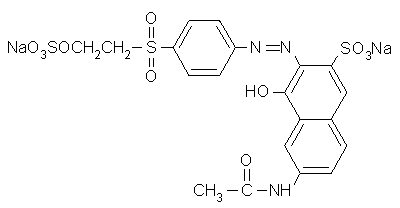 | Reactive Orange 16 | 2-Naphthalenesulfonic acid, 6-(acetylamino)- 4-hydroxy- 3-((4-((2-(sulfooxy)ethyl) sulfonyl)phenyl)azo)-, disodium salt |
| Reactive Orange 78 | [2-naphthalenesulfonic acid, 7-(acetylamino)- 4-hydroxy-3-((4-((2-(sulfooxy)ethyl) sulfonyl)phenyl)azo)-] CAS Reg. No. 68189-39-9) | |
| Reactive Red 180 | [5-(benzoylamino)-4-hydroxy-3-((1-sulfo- 6-((2-(sulfooxy)ethyl)sulfonyl)-2-naphthalenyl)azo)-2,7- naphthalenedisulfonic acid, tetrasodium salt] (CAS Reg. No. 98114-32-0) | |
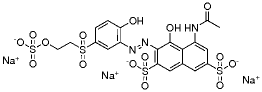 | Reactive Violet 5 | 5-(Acetylamino)-4-hydroxy-3-[[2-hydroxy-4-[[2-(sulfooxy)ethyl]sulfonyl]phenyl]azo]-2,7-naphthalenedisulfonic acid trisodium salt [CAS 12226-38-9] |
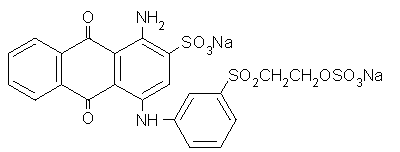 | Reactive Blue No. 19 | [2-anthracene-sulfonic acid, 1-amino-9,10- dihydro-9,10-dioxo-4-((3-((2-(sulfooxy)ethyl)sulfonyl)phenyl)amino)-, disodium salt] (CAS Reg. No. 2580-78-1) |
| Reactive Blue 21 | [copper, (29H,31H-phthalocyaninato(2-)- N29,N30,N31,N32)-, sulfo((4-((2- sulfooxy)ethyl)sulfonyl)phenyl)amino) sulfonyl derivs] (CAS Reg. No. 73049-92-0) | |
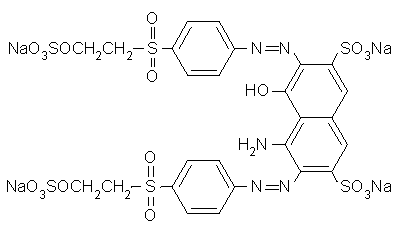 | Reactive Black 5 | [2,7-naphthalenedisulfonic acid, 4-amino-5- hydroxy-3,6-bis((4-((2-(sulfooxy)ethyl)sulfonyl)phenyl)azo)-tetrasodium salt] (CAS Reg. No. 17095-24-8) |
Vinyl sulfone dyes are particularly useful for chemical resist dyeing, in which two different types of fiber reactive dyes are used to print foreground and background in different colors. This technique allows you to print one color right on top of another color, such as bright yellow figures on a dark blue background, without having to do a separate discharge step.
One method is to mix either Cibacron F or Procion MX dye with soda ash and a chemical called BASF Chemical Resist, apply it to cotton fabric, let it dry, then mix up remazol dye with soda ash or 'Basilen Fixing Agent', apply it to the same piece of fabric, and then steam the piece. The result is a design of Procion MX or Cibacron F dye surrounded by a background of Remazol dye. The Remazol dye does not react with the fabric where the chemical resist has been placed.
DyersLIST list-owner Pat William provided instructions for chemical resist dyeing with remazol dyes on two pages whcih were located on the DyersLIST website at Eastern Michigan University. They are no longer there, but the Internet Archive still makes them available. Here are links for the two PDF pages with the instructions:

Kate Wells gives recipes for chemical resist printing, including specific recommendations for which Remazol dyes are the best choices to use, in her book Fabric Dyeing and Printing
It appears that there are no longer any known sources for buying BASF Chemical Resist. (For speculation as to what chemical(s) may have been contained in BASF Chemical Resist, see the Dye Forum discussions, "chemical resist dyeing with fiber reactive dyes" and "Looking for the Liquid Reactive Resist Agent for Chemical Resist.")
The resist chemical used to prevent the vinyl sulfone dyes from attaching to the fabric is sold by Jacquard Products under the name Chemical Reactive Resist. Their web site lists four mail-order sources in the US: Binders Art Supplies and Frames, Fabrics to Dye For, Bates Art & Designs Supply, and Hull's Art Supply and Framing. The chemical, previously known as BASF Chemical Reactive Resist, is also available in industrial quantities from BTC Specialty Chemical Distribution.
A good alternative for contrasting colors in figure and ground is to first dye the fabric with a reactive dye that discharges well with a reducing discharge agent, then overprint with a vat dye; the reducing agents required for solubilizing the vat dyes will also discharge suitable reactive dyes.
Last updated: September 30, 2011
Page created: May 1, 2005
Downloaded: Sunday, September 13, 2026